
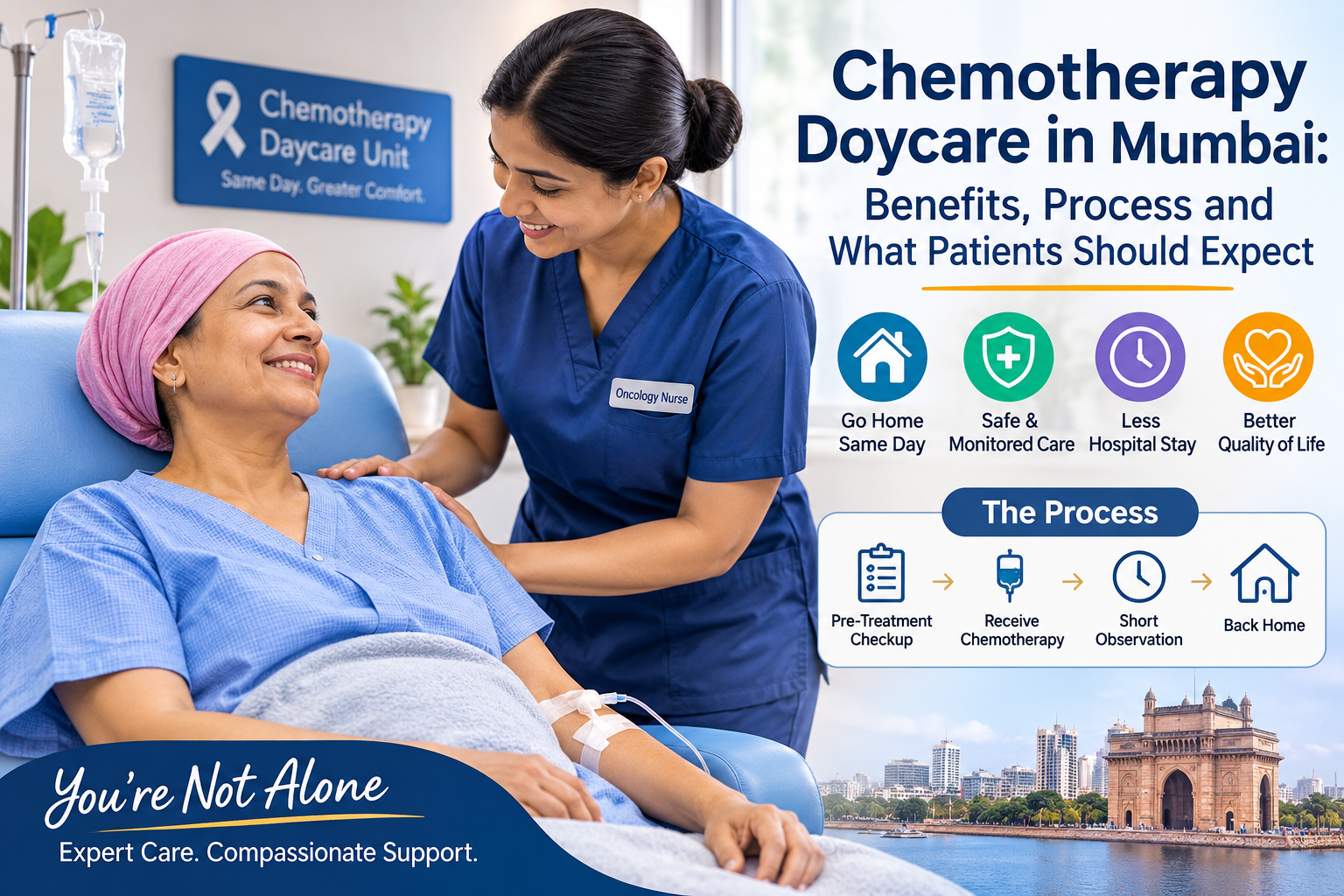
Chemotherapy daycare lets suitable patients receive their chemo medicines in an outpatient unit and go home the same day, under the watch of oncology nurses and doctors. Your oncologist decides whether this is right for you.
Hearing that you or someone you love needs chemotherapy can make the whole room go quiet. Suddenly there are new words, new fears and a hundred questions, and most of them begin with “Will we be able to manage this?”
If you have been quietly searching what’s chemotherapy late at night, you are not alone. Almost every family does the same. This guide explains it in plain language, from how the medicines work to what a day at a daycare unit actually looks like, so you walk in prepared rather than anxious.
One note before we begin. Every patient’s plan is different. Your oncologist decides the medicines, the schedule and whether outpatient treatment suits you. Please read this as a friendly explainer, not as a prescription.
What Is Chemotherapy?
In simple words, cancer chemotherapy means using strong medicines to destroy cancer cells or stop them from growing and dividing. Cancer cells multiply much faster than most healthy cells, and these drugs are designed to target exactly that fast-dividing behaviour.
The medicines travel through the bloodstream, so they can reach cancer cells almost anywhere in the body. That is why chemo is called a systemic treatment. Surgery and radiation, in comparison, work on one specific area.
Doctors may use chemo on its own or along with surgery, radiation, targeted therapy or immunotherapy. The goal changes from person to person. It may be to cure the cancer, to keep it under control, to shrink a tumour before surgery, or to ease symptoms.
At home and in clinics, you may hear it called many things: the drip, a cycle, a sitting, or simply cancer treatment chemo. All of them point to the same thing, which is a planned course of cancer-fighting medicines.
What Is Chemotherapy Treatment and How Does It Work?
So, what is chemotherapy treatment in everyday practice? It is a planned course of anti-cancer drugs given in repeating cycles. A cycle may be a day of medicine followed by a few weeks of rest, so your body gets time to recover before the next round.
Cells grow and divide in stages. Chemo drugs interfere with those stages. Some damage the cell’s DNA, while others block what a cell needs to copy itself. Cancer cells, which divide quickly and often carelessly, are hit hardest.
Some healthy cells also divide fast, such as those in hair roots, the lining of the mouth and the bone marrow. They can be affected too. This is why side effects like hair loss, mouth sores and low blood counts happen, and why your team checks your blood reports so closely.
Chemo can be given in a few ways. The most common is through a vein, known as IV chemo. Some medicines come as tablets or capsules that you take at home, and a few are given as injections. Your oncologist picks the route based on the drug and the type of cancer.
How many cycles you need, and how strong each dose is, depends on the cancer type, its stage, your general health, your blood tests and the goal of treatment. Comparing your schedule with someone else’s can therefore be misleading.
What Is Chemotherapy Daycare?
Daycare chemotherapy treatment means you receive your medicines in a dedicated outpatient unit and go home the same day, without being admitted overnight. You arrive, get checked, receive your treatment, rest under observation and leave with clear instructions.
A good daycare unit has trained oncology nurses, doctors on call and support staff who watch you before, during and after the session. Both IV and oral chemo can be managed this way, along with the blood tests and pre-medicines needed to keep each session safe.
Think of it as a well-organised clinic visit rather than a hospital stay. The medical care is serious, but the setting is calmer and the disruption to your home life is smaller.
It is important to be clear about one thing. Not every regimen or every patient is suited to daycare. Some drug combinations need longer monitoring, and some patients need admission because of their health at that time. Your treating oncologist makes that call.
Important Benefits of Daycare Chemotherapy Treatment
Let us first talk about why chemo is given at all. The chemotherapy benefits you can expect depend on your cancer and the purpose of treatment. For some cancers it can cure the disease. For others it can keep the cancer under control for a long time, shrink a tumour so surgery becomes easier, or reduce the chance of the cancer coming back after surgery. It can also relieve pain and other symptoms. Results vary, and no responsible doctor can promise a particular outcome.
Now the daycare part. The biggest gain is that you sleep in your own bed. For most people, being home with family, familiar food and a normal routine makes a hard treatment feel a little lighter.
Daycare also cuts down on time spent in hospital. There is no long admission, and many patients find it easier to return to light work or daily routines between cycles, if their doctor agrees.
Families benefit too. Caregivers can plan their day, take a break and still be reachable. Children and elderly parents at home see you every evening, which helps everyone emotionally.
Finally, daycare units focus on one thing, which is giving treatment safely. That focus often means smoother scheduling, shorter waits and nurses who are used to answering the small questions patients are shy to ask.
How Does the Chemotherapy Treatment Process Work?
Every chemotherapy treatment day follows a rhythm. Knowing that rhythm takes away a lot of fear, so here it is, step by step.
Before the Chemotherapy Session
Your oncologist first confirms the plan: the drugs, the dose and the number of cycles. Before each session you will usually have blood tests to check that your body is ready, and a quick check of your weight, vitals and how you have been feeling.
Please tell the team about any fever, vomiting, mouth sores, new pain or other medicines you have taken since the last cycle. Even small things matter.
Then you are given pre-medicines, which may include anti-nausea drugs and medicines to prevent allergic reactions. Eat a light meal unless told otherwise, and drink water as advised.
During the Chemotherapy Session
You settle into a reclining chair or bed. A nurse checks your identity and the medicine details, then starts the drip through a vein, a cannula, or a central line if you have one.
The session can take anywhere from under an hour to several hours, depending on the drugs. Some medicines run slowly on purpose so that the body can tolerate them well.
Nurses keep an eye on you throughout. Tell them at once if you feel itching, breathlessness, chills, pain at the drip site or sudden dizziness. These are easy to fix when reported early.
After the Chemotherapy Session
Once the infusion finishes, you are usually observed for a short while, then the cannula is removed and you are given instructions in writing. These cover medicines to take at home, food and fluids, and the warning signs that need a phone call.
Plan for a companion to take you home. Some patients feel drowsy or tired afterwards, so avoid driving yourself if you have had sedating pre-medicines.
Your next visit, blood tests and follow-up consultation are fixed before you leave, so nothing is left hanging.
What Should Cancer Patients Expect During Chemotherapy?
Because chemotherapy treatment for cancer patients varies so much, the honest answer to “How will it feel?” is that it depends. Some people carry on with light daily routines. Others need more rest than they expected.
Fatigue is the most common complaint. Nausea, loss of appetite, mouth sores, hair thinning, constipation or loose motions, and tingling in hands and feet can occur with certain drugs. Many of these can be reduced with the right medicines, so please speak up rather than quietly bearing them.
Your immunity can dip a few days after a session, which makes infections more likely. Wash hands often, avoid crowded places when your counts are low, and eat freshly cooked food.
Call your oncology team straight away for fever (commonly 38°C or 100.4°F, or the limit your doctor has given you), chills, repeated vomiting, severe diarrhoea, bleeding, breathlessness or an inability to drink fluids. Do not wait for the next appointment.
Emotions go up and down as well. Worry, irritability and low moods are normal. Talk to your doctor, a counsellor or a trusted family member. You are not being weak by asking for support.
Chemotherapy Patient Care: Safety, Monitoring and Comfort
Chemotherapy patient care is much more than the drip itself. It is the checking, the watching and the listening that happen around it.
On the safety side, a good unit double-checks your identity, the drug and the dose before every infusion. It handles chemo medicines under strict preparation protocols and keeps emergency medicines and trained staff ready in case of a reaction.
On the monitoring side, your nurses track vitals during the session, and your oncologist reviews blood reports and symptoms between cycles to adjust doses or timing if needed.
Comfort matters just as much. A calm chair, a blanket, a quiet corner and a nurse who explains what is happening can change how a four-hour session feels.
Whole-person care also includes nutrition guidance, pain management and emotional support for patients and caregivers. These supportive services are part of treatment, not an add-on.
Daycare Chemotherapy vs Inpatient Chemotherapy
Both are safe and well-established ways to deliver chemo. The right one depends on your regimen and your health at that moment.
| Factor | Daycare Chemo | Inpatient Chemo |
|---|---|---|
| Stay | Same-day discharge | Overnight or multi-day admission |
| Suitable for | Many standard IV and oral regimens, in patients stable enough to go home | Longer or more intensive regimens, or patients who need close monitoring |
| Monitoring | Before, during and shortly after the session | Round-the-clock |
| Comfort and routine | Sleep at home, familiar surroundings | Hospital environment |
| Family involvement | Easier for caregivers to manage daily life | Caregiver often stays at hospital |
| Emergency access | Staff on site; admission arranged if needed | Hospital team available throughout |
| Who decides | Your treating oncologist | Your treating oncologist |
If you start in daycare and your condition changes, your oncologist can move you to inpatient care. That flexibility is a safety feature, not a failure of the plan.
How to Choose the Right Chemotherapy Centre in Mumbai
Choosing a chemotherapy centre in Mumbai is a big decision, and a few simple questions can make it easier.
Start with the doctors. Are the treating oncologists qualified in medical or haemato-oncology, and will you meet the same doctor at each cycle?
Look at the nursing team. Chemo is delivered by nurses, so ask whether they are trained in oncology and how they handle reactions.
Ask what happens in an emergency. A good centre has a clear plan for reactions, fever or a sudden drop in counts, including a tie-up with a hospital for admission.
Check how treatment is planned. Does the team explain the regimen, the side effects and the expected schedule in a way you understand? Are costs discussed clearly before you begin?
Think about travel too. Mumbai traffic and local train crowds are real, and you may feel tired after a session. A centre that is easy to reach for you and your caregiver makes every cycle less stressful.
Lastly, visit if you can. Notice whether the unit is clean, calm and welcoming, and whether staff make eye contact and answer questions patiently.
Chemotherapy Daycare Centre in Chembur – Oorja Oncology Centre
If you are looking for a Chemotherapy daycare centre in Chembur, Oorja Oncology Centre is located at Unit 806 & 807, 8th Floor, Signature Business Park, Postal Colony Road, near Fine Arts Society, Chembur, Mumbai 400071.
According to the centre, its daycare unit offers intravenous and oral chemo with pre-treatment assessments and blood work, monitoring during treatment, post-treatment observation and follow-up advice, with oncology nurses and doctors involved at each stage and same-day discharge for suitable patients.
Treatment at Oorja is led by Dr. Suhas Agre, Medical Oncologist, who works with solid tumours such as breast, lung, gastrointestinal and head and neck cancers, and Dr. Madhura Ambekar Agre, Haemato-Oncologist, who treats blood cancers such as leukaemia, lymphoma and myeloma.
The centre also provides targeted therapy, immunotherapy, precision therapy and supportive services such as nutritional counselling, pain management and emotional support, so your treatment plan can be built around you instead of a template.
Whether daycare is suitable for you will be decided by your oncologist after reviewing your reports and health. If you want a second opinion on your current plan, that is welcome too.
To book a consultation, call +91 85919 19747 or use the appointment form on the Oorja website. Bring your reports and a family member if you can.
Frequently Asked Questions
What’s chemotherapy?
Chemotherapy is a cancer treatment that uses powerful medicines to destroy cancer cells or stop them from multiplying. Because the drugs travel through the blood, they can act on cancer cells throughout the body.
What is chemotherapy treatment?
It is a planned course of anti-cancer medicines, usually given in cycles with rest periods in between. The drugs, doses and number of cycles depend on your cancer type, stage, health and the goal of treatment.
What are the benefits of chemotherapy?
Depending on the situation, chemo may cure certain cancers, control growth, shrink a tumour before surgery, lower the risk of recurrence after surgery or relieve symptoms. Outcomes differ for each person, and your oncologist can explain what is realistic in your case.
How does daycare chemotherapy treatment work?
You visit the unit on a scheduled day, get blood tests and a health check, receive pre-medicines, then your chemo as a drip or tablets under nurse supervision. After a short observation period you go home with written instructions.
How long does a chemotherapy session take?
It varies widely. Some injections take minutes, while many infusions take a few hours, and some regimens run longer. With checks and observation, plan for a good part of the day and ask your team for an estimate.
Is chemotherapy daycare safe?
For suitable patients, yes. Safety comes from careful selection by your oncologist, trained nurses, pre-medicines, monitoring and a clear emergency plan. Patients who need closer watch may be advised inpatient care instead.
What should patients bring for chemotherapy?
Bring your ID, appointment details, previous reports, a list of current medicines, comfortable clothes, a light sweater, water, a simple snack if allowed, a phone charger and something to read. A family member or friend for company is helpful.
What happens after a chemotherapy session?
You are observed briefly, the cannula is removed and you receive instructions on medicines, food, fluids and warning signs. Tiredness, nausea or a metallic taste can appear in the next few days, and your team will tell you who to call if they worsen.
Can patients return home after chemotherapy?
In daycare, yes, once the team is satisfied you are stable. Go with a companion, rest well and follow the home-care instructions closely.
How do I find a chemotherapy centre in Mumbai?
Ask your oncologist for a recommendation, then compare centres on doctor expertise, nursing team, emergency arrangements, cost clarity and ease of travel. Visiting in person before you decide is worthwhile.
Where is a chemotherapy daycare centre in Chembur?
Oorja Oncology Centre is at Unit 806 & 807, 8th Floor, Signature Business Park, Postal Colony Road, near Fine Arts Society, Chembur, Mumbai 400071. You can call +91 85919 19747 to book an appointment.